

![]() He changeth not...
He changeth not...
 Unchanging faithfulness
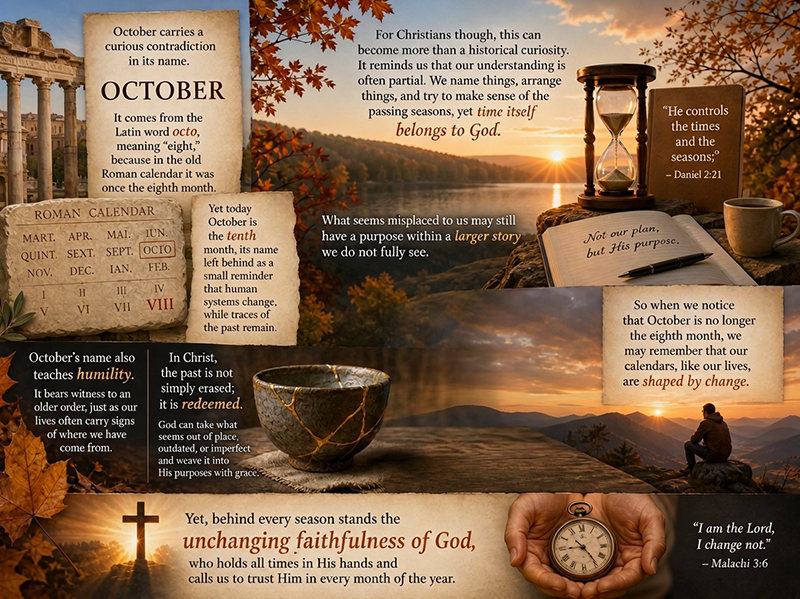
October carries a curious contradiction in its name. It comes from the Latin word octo, meaning “eight,” because in the old Roman calendar it was once the eighth month. Yet today October is the tenth month, its name left behind as a small reminder that human systems change, while traces of the past remain.
For Christians, though, this can become more than a historical curiosity. It reminds us that our understanding is often partial. We name things, arrange things, and try to make sense of the passing seasons, yet time itself belongs to God. What seems misplaced to us may still have a purpose within a larger story we do not fully see.
Adopting the Gregorian calendar
 Where does the time go...?
This September, many of us may lament how quickly the year is passing. Yet in September 1752, time really did seem to vanish.
According to History UK, Britain and its Empire adopted a new calendar that year. Until then, they had followed the Julian calendar, introduced by Julius Caesar in 46 BC. But a small error in calculating the solar year—11 minutes each year—had shifted the calendar by a day every 128 years, gradually moving Easter away from the spring equinox.
The Gregorian calendar was introduced to correct this. Based on a 365-day year, with leap years adding a day to February every four years, it brought Britain into line with the more accurate system. The change was complicated: 1751 lasted only 282 days, running from 25 March, the Julian New Year, to 31 December, before 1752 began on 1 January.
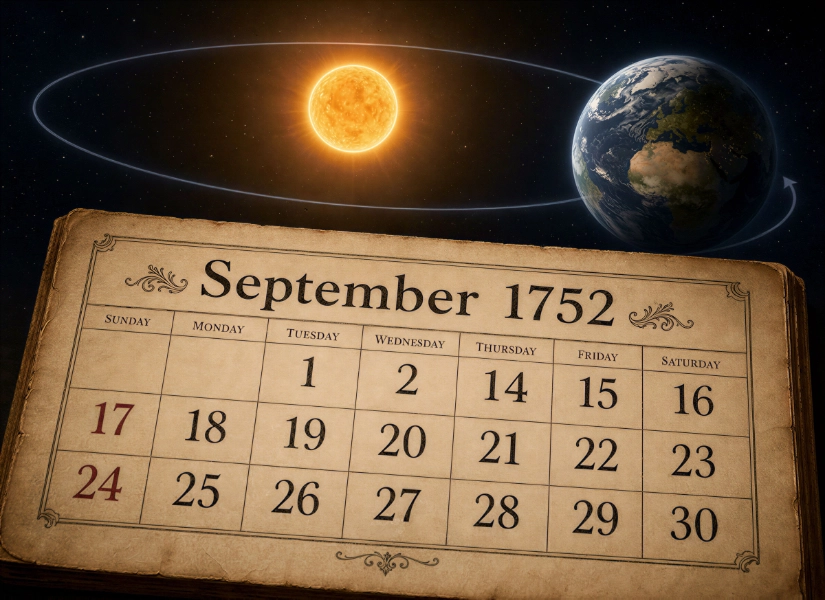
One problem remained: England’s calendar still had to be aligned with Europe’s. To correct the 11-day difference, Wednesday 2 September 1752 was followed by Thursday 14 September.
Yes, 11 days just disappeared!
Scarecrow Time
 Let us not grow weary...
This August, the annual Mortehoe Scarecrow Festival will be in full swing. It runs from 31st July until 3rd August, from 10.30 – 16.30 pm. Over the weekend, you are invited to call in at the Museum to collect a score card and then explore the village to search for the characters listed. This year the theme is ‘Pantomime Characters.’ If I know anything about it, it will be imaginative, funny and something utterly worth turning out for. When you have finished trying to find all the characters, you are invited to give your score card in for the chance of winning a prize in several categories. There will be a barbecue and craft fair to enjoy too.
There is something wonderfully ordinary about a scarecrow. Dressed in cast-off clothes, propped up with a pole, and left to face the changing weather, it stands in a field with a task so simple that it is almost easy to miss. It is there to guard what has been planted; it cannot make the seed grow. It cannot command the sun to shine or the rain to fall. Yet it remains in place, quietly witnessing to the hope of harvest.
And in July?
 What will July bring?
As I sit writing this article in preparation for the July edition of the magazine, I can’t help but wonder what July will bring. Will it be a warmer and drier month than June? Will it be a good season for those whose businesses rely on an influx of happy holidaymakers? Will farmers reap good crops? Time, of course, will tell, but my question made me think about expectations and our response to them.
From what I have learned over the years, expectations shape the way we see the world. They influence how we wait, how we respond to disappointment and how we end up seeing ourselves. Unmet expectations can feel like failure, silence, or rejection. We may pray for healing, change, reconciliation, or clarity, and yet the answer does not come in the way we hoped. In those moments, faith does not require us to pretend we are not disappointed. We bring our confusion to God because we believe he is still present, still good, and still listening.
Oops...
 We all make mistakes...
For those in the know, I made a mistake last month when I provided the dates for the forthcoming Mission Community Morning Prayer. Instead of listing Tuesdays of the month, I confused everyone and sent the dates for Mondays in May instead. It was only when a kind, confused Churchwarden noticed the error that I realised what I had done. Therefore, please accept my apologies; however, it made me reflect on my error and, indeed, my fallibility as a human being.
The famous line, “To err is human, to forgive, divine,” was written by the English poet Alexander Pope in 1711. It appears in his poem An Essay on Criticism, which highlights the human tendency to make mistakes and contrasts it with the divine nature of forgiveness.